
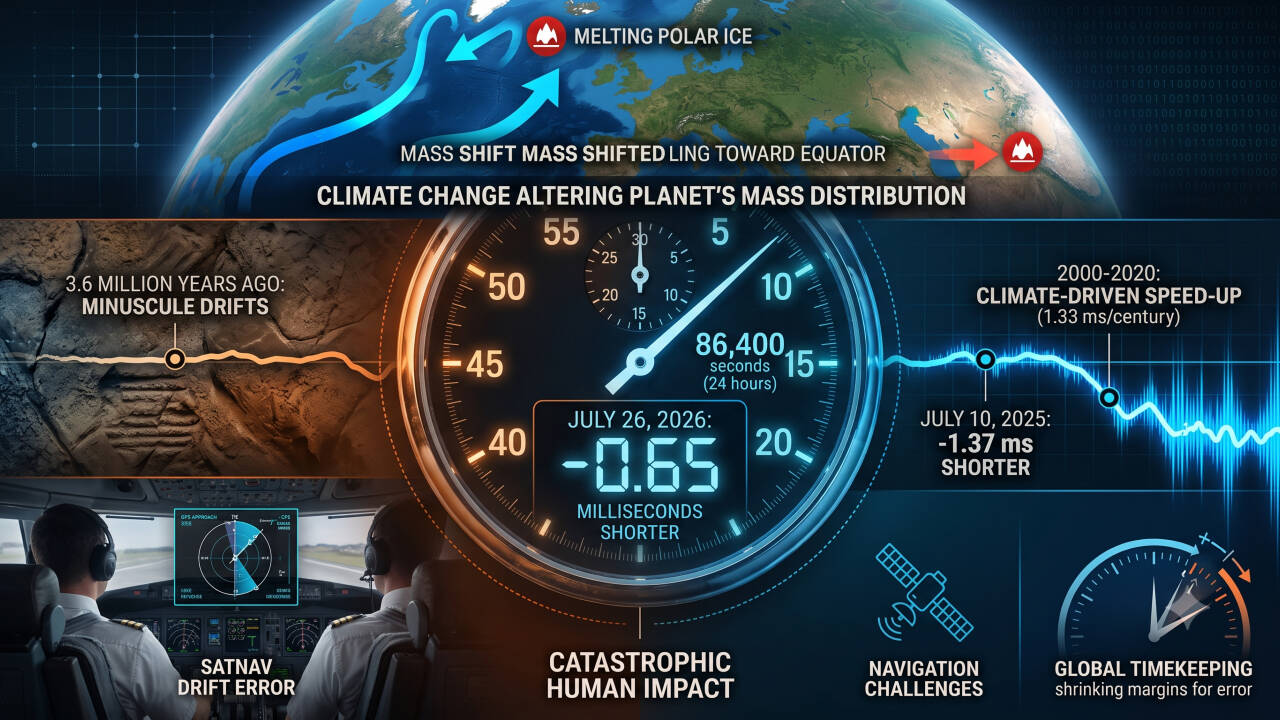
Earth’s rotation is changing, with July 26, 2026, marking the shortest day by a tiny margin. This subtle shift is linked to climate change and its impact on mass distribution. Scientists observe Earth’s day lengthening at a rate unseen for millions of years. Modern navigation and timekeeping systems rely on precise rotation data. Future adjustments will become more complex as these changes continue. Earth’s rotation is changing, with July 26, 2026, marking the shortest day by a tiny margin. This subtle shift is linked to climate change and its impact on mass distribution. Scientists observe Earth’s day lengthening at a rate unseen for millions of years. Modern navigation and timekeeping systems rely on precise rotation data. Future adjustments will become more complex as these changes continue.
Trending
- ‘Salute demonstrators … Modi-Shah too will go’: Opposition on Pradhan’s resignation; who said what
- ‘To ensure anti-national elements don’t benefit from situation’: Dharmendra Pradhan resigns – read full letter
- Millions with desk jobs, millions with cervical pain
- Dharmendra Pradhan resigns as Union education minister amid massive student protests
- What is the Public Examinations Amendment Bill? Govt proposes sweeping changes to anti-cheating law
- Ghost flats explained: Why some fully built homes remain empty despite India’s housing shortage
- ‘First it hurt me, later I took advantage’: FM Nirmala Sitharaman’s paper leak remarks spark political row
- ‘Shortest day of 2026’: How this ‘milli-seconds shift’ is threatening GPS and satellites

‘Shortest day of 2026’: How this ‘milli-seconds shift’ is threatening GPS and satellites
 By
By

Add A Comment