
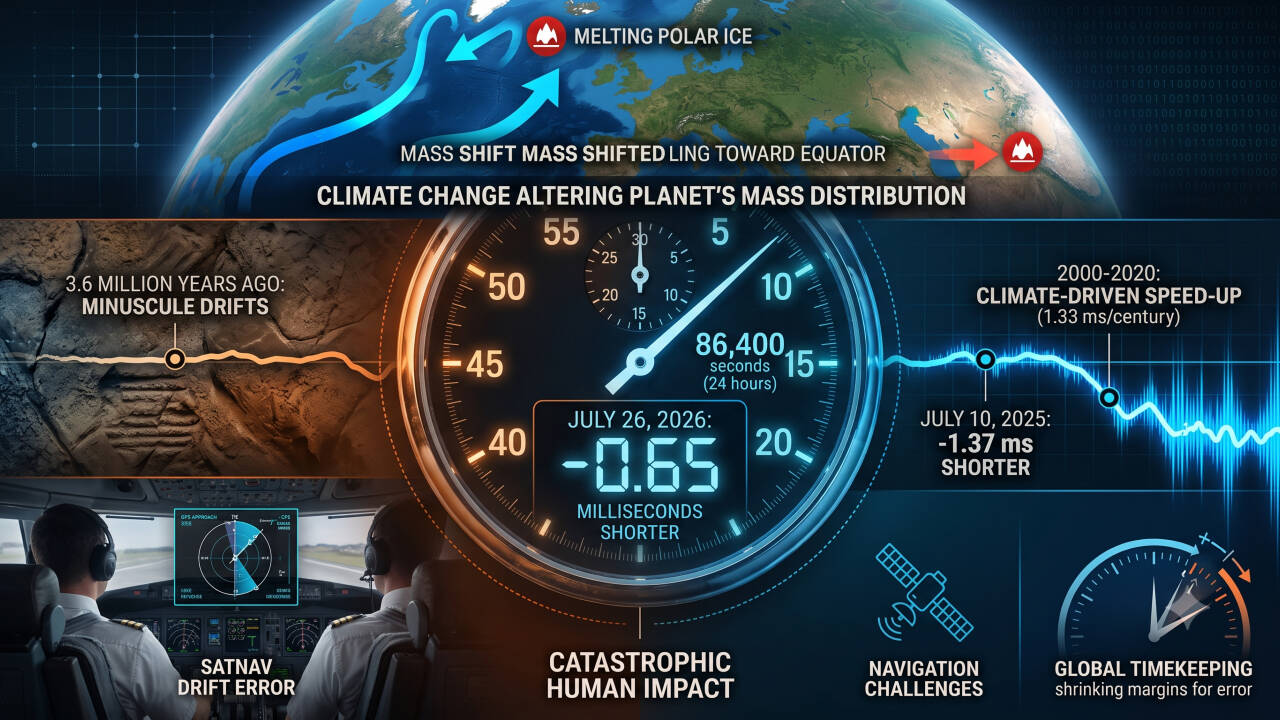
Earth’s rotation is changing, with July 26, 2026, marking the shortest day by a tiny margin. This subtle shift is linked to climate change and its impact on mass distribution. Scientists observe Earth’s day lengthening at a rate unseen for millions of years. Modern navigation and timekeeping systems rely on precise rotation data. Future adjustments will become more complex as these changes continue. Earth’s rotation is changing, with July 26, 2026, marking the shortest day by a tiny margin. This subtle shift is linked to climate change and its impact on mass distribution. Scientists observe Earth’s day lengthening at a rate unseen for millions of years. Modern navigation and timekeeping systems rely on precise rotation data. Future adjustments will become more complex as these changes continue.
Trending
- ‘First it hurt me, later I took advantage’: FM Nirmala Sitharaman’s paper leak remarks spark political row
- ‘Shortest day of 2026’: How this ‘milli-seconds shift’ is threatening GPS and satellites
- Canva’s billionaire founders donated $150 million directly to residents of Malawi; aided 90% rise above extreme poverty
- Sergey Brin back as world’s third richest after Google’s $255bn wipeout
- Oppn rebuffs PM’s late-night video, proposed Fast Track Court law
- Bihar bandh: Tej Pratap Yadav detained as NEET protests intensify
- Army rescues 57 stranded as major flood relief operation begins in Gujarat’s Navsari
- ‘Sack Pradhan from Cabinet’: Rahul says ministerial reshuffle won’t quell protest

‘Shortest day of 2026’: How this ‘milli-seconds shift’ is threatening GPS and satellites
 By
By

Add A Comment