
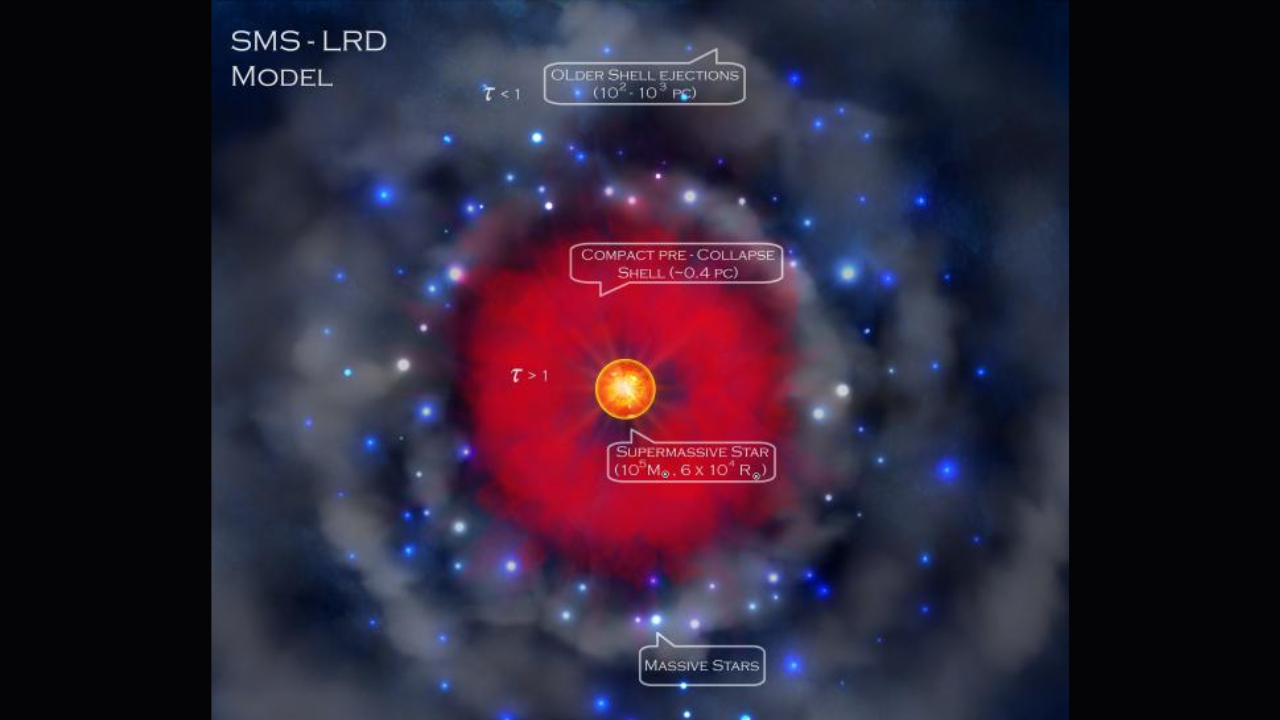
Recent findings indicate that colossal “monster stars,” reaching masses up to 100,000 times that of our Sun, may hold the key to understanding the enigmatic “little red dots” observed in the early universe. These gigantic stars, through their tumultuous pulsations, generate dense gas shells that may facilitate the swift emergence of supermassive black holes. This innovative research presents a comprehensive model to account for the characteristics of these cosmic phenomena. Recent findings indicate that colossal “monster stars,” reaching masses up to 100,000 times that of our Sun, may hold the key to understanding the enigmatic “little red dots” observed in the early universe. These gigantic stars, through their tumultuous pulsations, generate dense gas shells that may facilitate the swift emergence of supermassive black holes. This innovative research presents a comprehensive model to account for the characteristics of these cosmic phenomena.
Trending
- ‘He deserves to be remembered’: British man who wrongly spent 11 years in jail raises funds to restore murder victim’s grave
- Chicago homeowner sues US govt over alleged warrantless immigration raid that damaged property
- Saudi Prince’s $450 million superyacht hides a secret cabin deep inside the hull, designed to…
- Kevin O’Leary says Wall Street boom may not decide the 2026 US elections
- Indian-origin PhD student found dead in lake after going missing on solo hiking trip
- Drunk Bengaluru designer fires airgun from apartment balcony, residents run for cover
- England fast bowler announces shock retirement from cricket at 25
- ‘Islamification of the country has to stop’: McKinney council meeting extends for 5 hours over debate on mosque project, plan gets nod after massive fight

James Webb’s little red dots may be monster stars that seeded black holes
 By
By

Add A Comment